Regulatory status, registry and asset minting

Triangle Digital is licensed by the Bermuda Monetary Authority under the Digital Asset Business Act for the issuance and sale of digital assets. This page explains the regulatory framework, registry operations and asset minting processes for institutional stakeholders.

Our regulatory foundation

Licensed where it counts

Triangle is an approved digital asset broker-dealer under Bermuda's Digital Asset Business Act (DABA), enacted in 2018, regulated by the Bermuda Monetary Authority.

The BMA is globally recognized as a leading financial regulator, particularly in insurance and reinsurance as the world's foremost market for catastrophe bonds. Bermuda established itself as a premier digital asset jurisdiction in 2018 alongside institutions such as Coinbase, Circle, Kraken and Gemini.

Under this framework Triangle is approved to issue and sell digital assets. Every asset issued is listed on Triangle's Asset Registry, overseen by the BMA under the Ministry of Finance.

That status is not a compliance formality. It is what lets banks and qualified custodians hold, collateralize and structure products around carbon credits.

By creating regulated financial instruments, Triangle turns carbon credits from stranded, illiquid holdings into tradable assets. The market moves from buy and retire to buy and bank, which is what drives pricing, velocity, liquidity and scaled impact investment.

Regulator
Bermuda Monetary Authority
Legislation
Digital Asset Business Act 2018
Ministry
Ministry of Finance, Bermuda
Status
Approved digital asset broker-dealer
Digital commodity framework

Which regulator, at which stage

Under the emerging U.S. Clarity Act framework, Triangle's carbon credits are treated as digital commodities, which places them under CFTC oversight rather than SEC securities regulation.

The Act defines a digital commodity as a fungible digital asset that confers no rights to profits, liquidation proceeds or governance, a definition carbon credits satisfy. Triangle tokens confer no equity, profit-sharing or governance rights, which is the distinction that matters to banks and asset managers operating under securities law constraints.

As digital commodities they sit with the regulator that oversees oil, gold and agricultural futures, a familiar framework for institutional participants, and the combination with BMA regulation satisfies both offshore and U.S. institutional compliance requirements.

Classification under the Clarity Act depends on final rulemaking and on the facts of each issuance. Nothing here is legal advice, and counsel should confirm treatment before an institution relies on it.

StageRole and activityRegulatory body
Methodology standardsEstablish carbon accounting rules and protocolsICVCM, CORSIA, ISO
Project developmentImplement emission reduction or removal projectsProject developers
D-MRV and verificationDigital measurement, reporting and verificationTriangle and third-party verifiers
Asset issuanceMint regulated digital assetsTriangle, BMA-licensed
Registry and custodyRecord ownership and hold assetsTriangle Registry, qualified custodians
Trading and settlementBuy, sell and settle transactionsBMA and CFTC, Clarity Act
Retirement and reportingRetire for compliance or voluntary claimsIFRS, TCFD, CSRD, ISSB
The Triangle Registry

Data registry and asset registry

Triangle operates an Asset Registry that complements the carbon registries. When an asset is frozen or moved from a carbon registry to Triangle, the carbon registry becomes the Data Registry, analogous to the SEC's EDGAR for disclosure, and Triangle becomes the Asset Registry, analogous to the DTCC for settlement.

Project and methodology data

The disclosure layer. Documentation, standards and verification, public and auditable.

  • Project description documents
  • Methodology and protocol standards
  • Third-party verification reports
  • Baseline and monitoring data
  • ICVCM and CORSIA alignment documentation

Digital asset ownership and settlement

The settlement layer. The authoritative record of ownership and transaction history, on chain.

  • Token issuance records
  • Ownership and custody tracking
  • Transfer and settlement history
  • Retirement and cancellation records
  • BMA-overseen asset listings

Three core registry actions

Mint: create assets backed by verified project data, each linked to the underlying registry asset. Retire: cancel permanently to claim the offset, recorded on chain and in the registry as auditable proof for CSRD, TCFD and ISSB. Sell or transfer: move ownership between Triangle accounts, to external custodians, or back to registry accounts, each counterparty cleared through AML and KYC.

External registry asset minting

Two ways across

Triangle supports minting digital assets from credits that originate in external registries such as Verra, Gold Standard or ACR. Two pathways are available depending on the client's needs.

Mirrored assets are Triangle tokens representing credits held in external registries. They work the way American Depositary Receipts do: an instrument listed on one venue representing ownership of a holding on another. No assets are allocated or distributed to clients until title transfers to the Triangle FBO account or the underlying asset is received.

Ledger format, Triangle FBO

Credits stay in the external registry, frozen in a Triangle for-benefit-of account, with a corresponding token created on chain.

  • Credit stays in the external registry
  • Frozen in Triangle's FBO sub-account there
  • Triangle mints a corresponding token on chain
  • Backed one to one by the frozen credit
  • Retirement unfreezes and cancels at the registry

Digital asset format, external registry account

Credits transfer into a Triangle External Registry Account and convert fully into regulated digital assets on the platform.

  • Credit transferred to a Triangle account
  • Full conversion to regulated digital asset format
  • Token minted with complete project metadata
  • Repository created with verification documentation
  • Fully tradable under the BMA framework

How mirrored assets work

One instrument representing another, kept in sync and backed one to one, with retirement cancelling both sides.
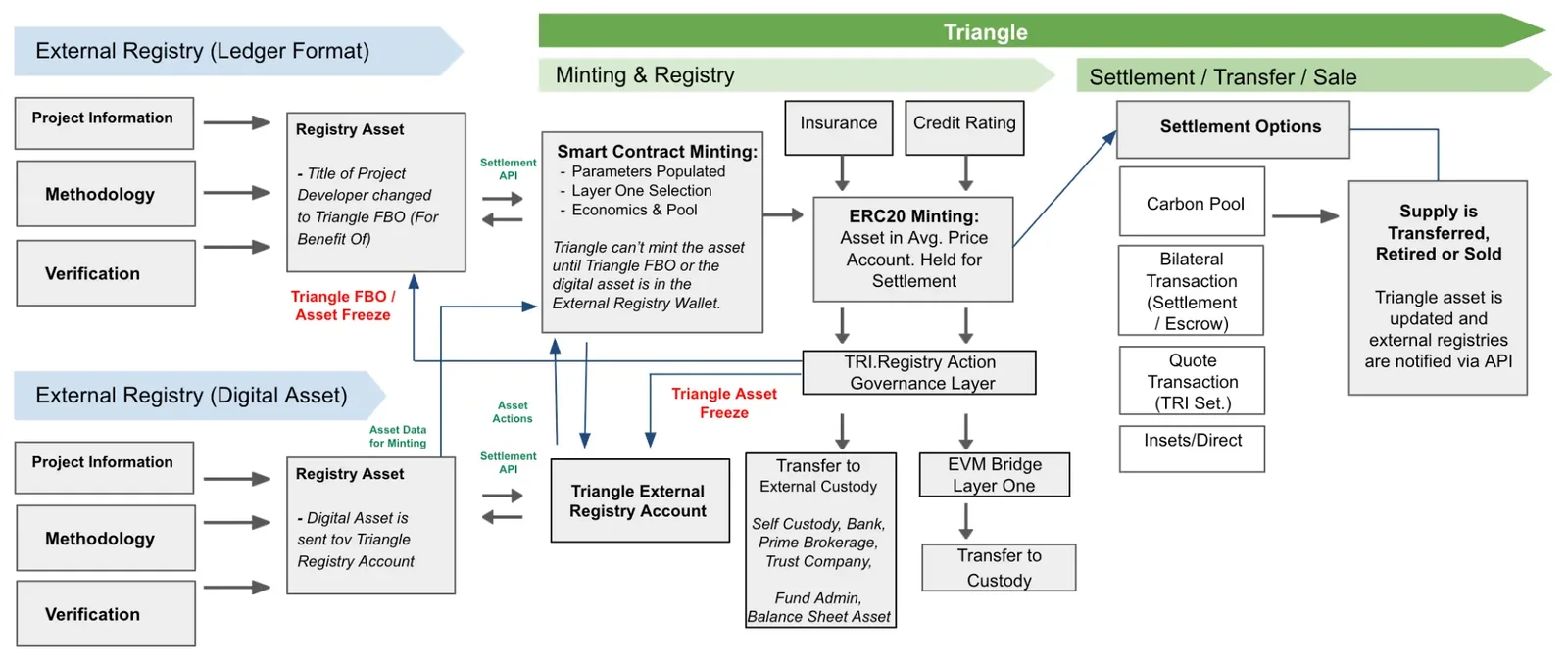
External registry minting: ledger format and digital asset format pathways
FeatureADR or GDR in traditional financeTriangle mirrored asset
Underlying assetForeign-listed equity shareExternal registry carbon credit
RepresentationUS-listed depositary receiptDigital token
Backing instrumentDepositary bank holds the sharesLedger or repository with cryptographic proof
SynchronizationCorporate action updatesReal-time sync with the external registry
Regulatory frameworkSEC and FINRABMA, DABA 2018
SettlementDTC and DTCCTriangle Registry
RetirementShare cancellationToken burn and registry credit cancellation
Triangle-native asset minting

From assessment to custody

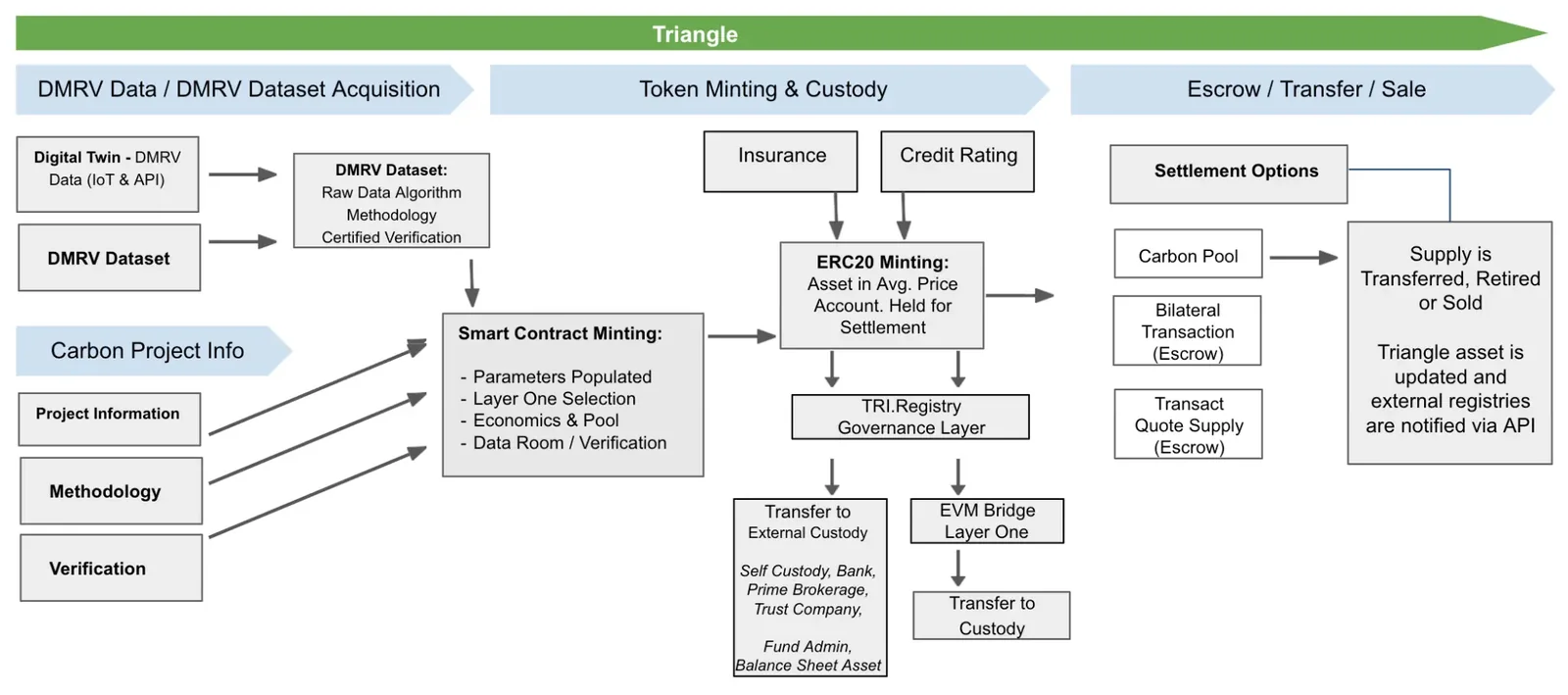
For assets created natively on the platform using digital MRV, minting follows an end-to-end workflow.

1

Initial assessment

The developer submits project information and methodology data, which screens for high-impact, high-return potential.

2

Data aggregation

IoT sensors, utility bills, satellite imagery and public datasets are aggregated. Digital twin technology links each asset to its sources through smart contracts, creating a unique hashed digital ID.

3

Reporting and verification

A dynamic baseline keeps claimed credits tied to carbon actually sequestered or avoided. Third-party attestation through local and global verifier networks provides assessments aligned with CORSIA, NIST and ISO 14064, 14065 and 14066.

4

Project repository and ledger

Historical and projected climate data is consolidated into an immutable repository, the reference asset from which fungible credits are created.

5

Smart contract minting

The minting process populates parameters, selects the chain, establishes economics and pool allocations, and holds the asset for settlement.

6

Settlement and custody

Settlement by card, bilateral transaction or quoted supply, then transfer to external custody: self-custody, banks, prime brokerages, trust companies, fund administrators or balance sheet holdings.

Triangle-native minting flow, assessment through settlement and custody
Two legislative pillars

DABA and DAIA

The BMA distinguishes between two frameworks governing digital asset activity, and the distinction matters to anyone engaging with Triangle's minting and registry operations.

Under the Digital Asset Issuance Act 2020, the BMA regulates minting or offering a new digital asset to the public as a regulated issuance event. An issuance document, prospectus in style, discloses technical standards, the smart contract, the hard cap and the rights attached to the asset.

The infrastructure used to facilitate minting and listing sits under DABA 2018. Operating a platform to onboard users, process subscriptions or facilitate minting, for yourself or others, is digital asset business; Triangle holds a Class M licence. Clients can use qualified custodians, self-custody or Triangle's own arrangements.

The BMA takes a substance-over-form approach. If staging for minting looks like a public offering, it is regulated under DAIA. Triangle, licensed under DABA, provides the platform that mints tokens for the clients it advises.

ActivityPrimary legislationBMA focus
The mintDAIA 2020Consumer protection and disclosure of asset economics
The platform and stagingDABA 2018Operational resilience and cybersecurity of the platform
Asset exchangeDABA 2018Quoting, bilateral transactions and carbon pool operations
AML, KYC and ATF

Everyone clears before anything moves

Every entity and asset that creates or transacts on the platform is subject to anti-money laundering, know-your-client and anti-terrorist-financing requirements. Triangle has operated a BMA-regulated digital asset platform for several years, and onboarding follows a five-step flow.

1

User registration

Access by site or registration link; other control members receive an onboarding email.

2

User profile

Automated AML and KYC scan, corporate profile and personal declarations, adverse news check.

3

Admin review

The Triangle admin team reviews documents and decides whether enhanced due diligence is required.

4

Enhanced due diligence

Additional diligence conducted against profile markers.

5

Risk flag confirmation

Digital ID created, risk score assigned, status granted or denied.

6

Compliance infrastructure

Third-party integrations for automated identity verification and AML screening, document verification and biometric authentication, and adverse news and media monitoring.

The difference

Regulated registry, traditional registry

Both hold a record. Only one produces something a bank can hold.

Feature or capabilityTraditional registryTriangle Registry
Regulatory statusNot availableRegulated under BMA, DABA 2018
AML, KYC and ATFNot requiredRequired
Bank custodyNot availableAvailable through qualified custodians
Balance sheet recognitionNot applicableAvailable as prepaid inventory
Asset manager recognitionNot applicableAvailable as a portfolio or fund asset
Collateral and lendingNot availableAvailable
Structured productsNot availableAvailable
Article 6VariesLetter of acceptance, ITMO tagged

Learn more

Next step

Ready to work with a regulated registry?

For institutional inquiries, compliance questions, or to begin onboarding, talk to the team.