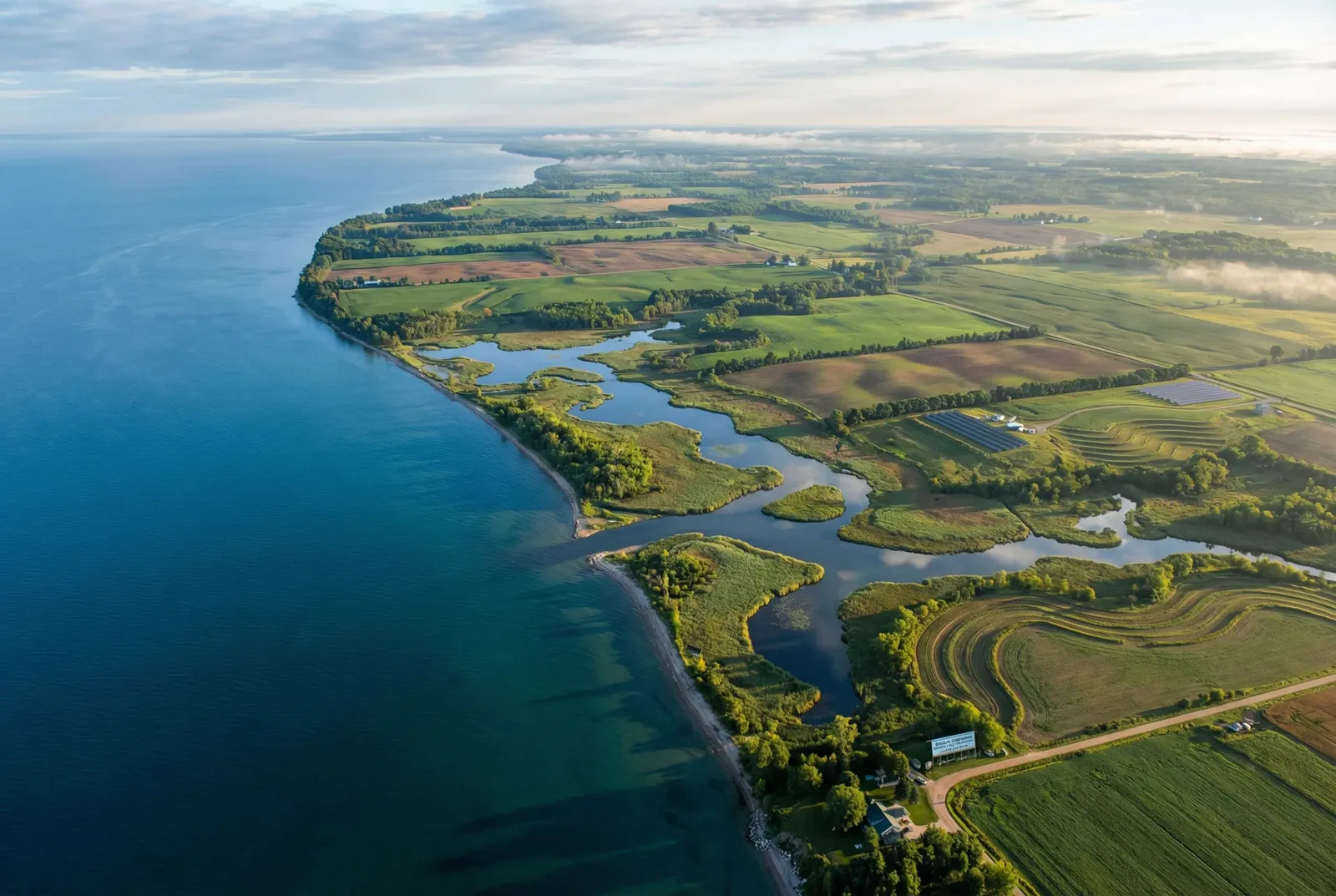
The University of Michigan, Triangle and LimnoTech, with funding from the Great Lakes Protection Fund and the Foundation for Food and Agriculture Research, are delivering regenerative agriculture and blended finance for American farmers.
Farmers and agricultural cooperatives have a new way to generate revenue, reduce borrowing costs and create income streams that raise profitability while improving resilience. As global markets evolve, agriculture sits at the centre of the next major asset class.
78.7% of capital in global equity and bond markets needs to comply with IFRS reporting requirements. That creates an economic incentive for farmers to adopt regenerative practices, to reach the lowest borrowing costs possible and keep selling their products all over the world.
The partnership enables regenerative solutions for the entire agricultural value chain, farmers, cooperatives, elevators, shippers, processors and manufacturers, to measure and manage sustainability while creating environmental credits for carbon, water and biodiversity that add value and increase resilience.
Aggregation, nesting and repackaging into bonds and ABS while maintaining traceability to every farm.
Regulated and pre-rated carbon credits combined within blended structures to reduce risk.
D-MRV systems, IoT, digital twins and distributed ledgers, for continuous KPI tracking and third-party audit.
Dynamic-rate smart contract functionality for streamlined, conditional disbursements.
No-till, cover crops, biologicals, methane capture, forestry. Existing data, verified at source.
Each credit a regulated asset with its methodology, verification and serial attached. Carbon, water and biodiversity.
Aggregated credits enter bonds, loans and ESG portfolios. Lower borrowing costs flow back to the farm.
CPGs, processors and financial institutions buy verified credits to meet mandatory reporting. The loop closes at the farm.
The market flow cycle: from soil to capital, whatever the farm size or crop.
Improve soil health, reduce input costs, increase yield and create environmental credits. Biologicals with no-till cover crop sequester 3 to 7 tonnes of carbon per acre.
Convert manure into renewable natural gas and create environmental credits. Brown is the new gold: methane capture turns waste into a revenue stream.
Spoilage and waste create carbon. Triangle partners use operating data to monitor and mint credits for reduced-waste activity.
Your land is worth more than you think. With a shapefile of the property, Triangle can remotely verify sequestration potential and create credits.
Regenerative practices you may already use can be converted into verified, tradeable carbon credits: new income, lower costs and access to premium markets, without disrupting the operation. The Carbon Warrant closes the loop: farmers pledge future credit revenue as collateral, and capital markets reward that with lower borrowing costs.
Direct cash payments on top of crop revenue. A 10,000-acre corn operation can add $300K to $1M or more a year without changing its core business.
Pledge future credit revenue as collateral, reduce loan interest and free working capital for equipment and inputs.
Regenerative practices open three credit markets at once. Water-quality co-benefits from cover crops and reduced runoff generate credits on top of sequestration.
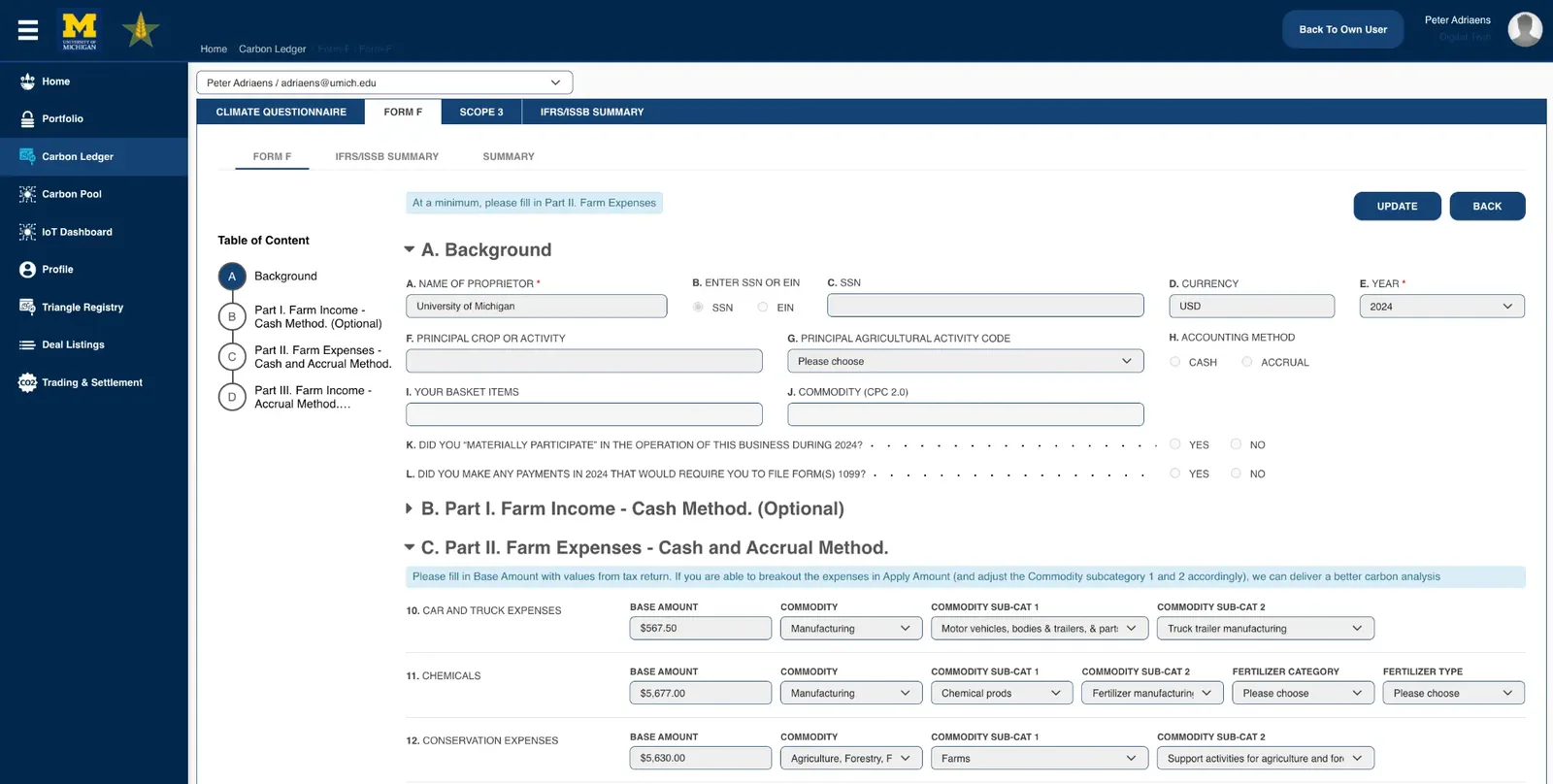
The platform works from your existing Schedule F and standard farm records. No new sensors, no costly audits: your documentation, turned into verified credits.
Predictable, multi-year income commitments: a hedge against commodity price swings and weather-driven revenue shocks.
Direct connection to Fortune 500 CPGs, food processors and financial institutions with mandatory Scope 3 reporting, the highest-value buyers in the market.
Initial assessment and farm profile. Add user information and a farm summary to establish the baseline. Under ten minutes.
Review the solutions that fit the operation. Add bank and off-taker information.
Load Schedule F and parcel identifiers, choose the solutions, and begin carbon farming.
Share the program with your bank for financing and Carbon Warrant issuance. Credits are custodied at your bank.
Using your existing Schedule F and the regenerative solutions that fit the farm, Triangle baselines the operation, connects solutions that add value, and creates fungible commodities that can be monetised. Adjust the inputs; every figure below recomputes.
| Metric | Baseline | Regen Ag |
|---|
| Year | Carbon price | Baseline net | Regen Ag net | Cumulative baseline | Cumulative Regen Ag |
|---|
Sources: S&P carbon estimates, 2025 $395 per tonne, 2030 $907, 2040 $2,000, 2050 $3,200. Inset and offset price forecast: $30 (2026 to 2027), $45 (2028 to 2029), $60 (2030 to 2031), $75 (2032 to 2035). Biologicals with no-till cover crop sequester 3 to 7 tonnes of carbon per acre. Insurance reduction reflects the improved risk profile of regenerative practices. Market prices are estimates; enter your own.
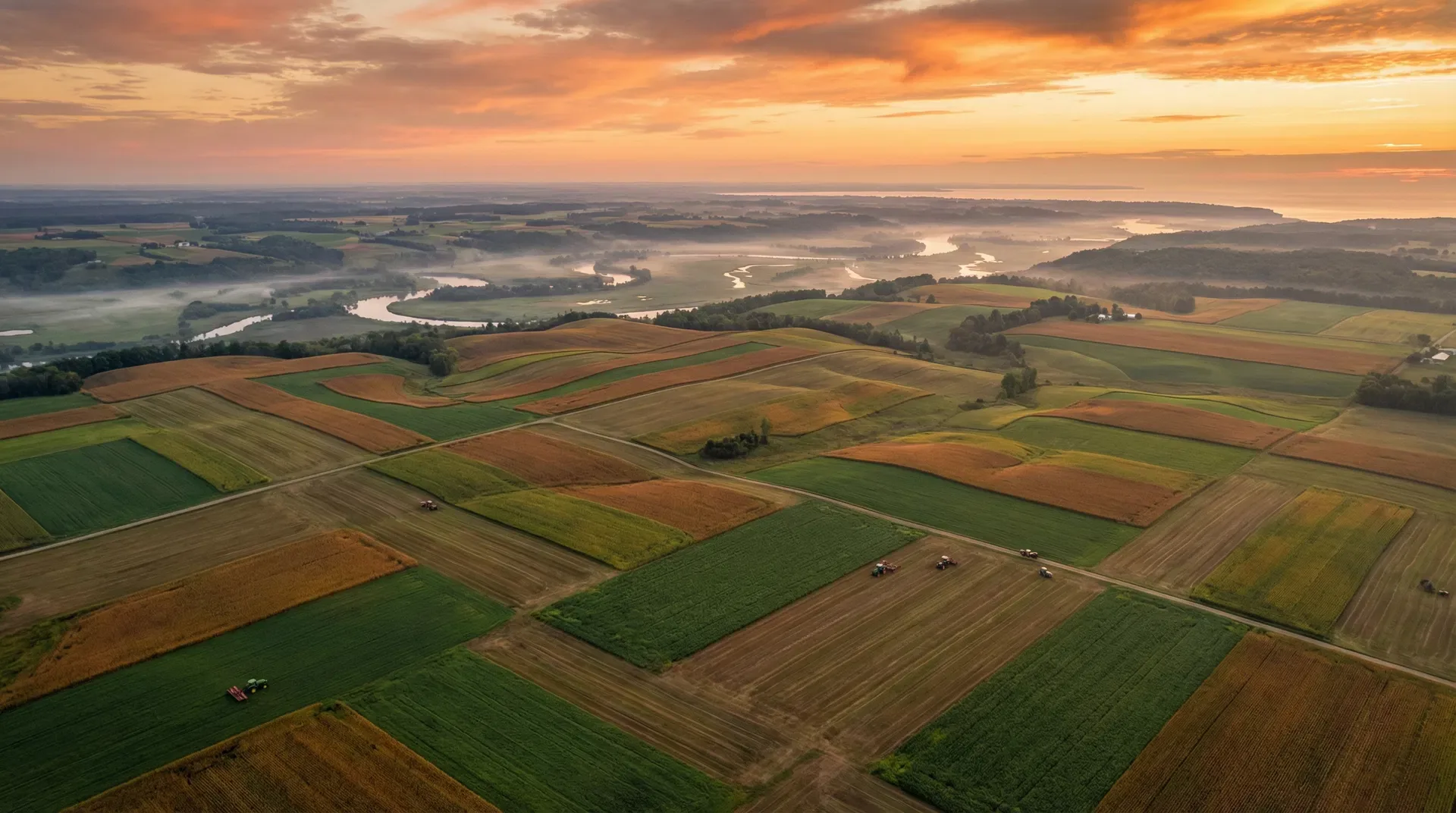
Partnerships with leading academic and environmental institutions provide the scientific foundation, data credibility and stakeholder trust that set the platform apart. In the Great Lakes region, water co-benefit credits protect watershed health while generating new revenue for farmers.
Provides the capital-market research that underpins Triangle's blended finance models and the demand case for credit infrastructure across agricultural fixed income.
Deep expertise in watershed health and water quality for the co-benefit credit framework. GLPF's mission to protect and restore the Great Lakes aligns with water co-benefit credits that quantify improvements in water quality from regenerative practice.
Accelerates the science behind the practices that generate carbon and co-benefit credits. FFAR's research into no-till cover crops, biologicals and soil health informs the methodology Triangle uses to quantify sequestration, the scientific backbone of every credit minted.
The D-MRV platform, blended finance structuring and minting infrastructure that tie the partnership together. The aggregation engine packages farm credits into regulated assets sized for capital markets.
A leading water and environmental engineering firm in Ann Arbor. Water quality modelling, Great Lakes hydrology and environmental data science support the co-benefit methodology and the monitoring that verifies nutrient reduction and watershed improvement.
Award-winning innovation and institutional partnerships.
The Triangle Carbon Ledger takes the farm's Schedule F and field data, baselines the operation, tracks the practices, and produces the reporting a bank, a buyer and an auditor each need, from the same record.
Farmer, aggregator, financial institution or research partner: the platform provides the infrastructure to take part in the carbon economy. Register and the team will baseline your operation at no cost.
Liquidity is a farm's first defense against financial stress. Strong liquidity increases flexibility, helps farms withstand political, market and environmental shocks, and positions them to expand acreage and improve productivity.
Agriculture team: ag@triangle.digital
The platform is supported by a growing ecosystem of financial, technology and institutional partners across the carbon market.
Add your aggregator or processor as a partner.
Contact usMeeting Scope 3 targets with verified credits from the supply chain you already buy from.
Contact usIntegrate your practice or product with the credit infrastructure.
Contact usCustody credits as collateral and price the practice into the loan.
Contact usTell us about your situation and we will route it to the right person.